The Most-Worn Shoe in Your House Cost You €9 and Has No Sole Left
Between October and March, most of your steps happen indoors — on tile, laminate and stone floors, in shoes you've never once thought about. Here's what that's quietly doing to your feet, and the fix that takes about thirty seconds.
 Sophie M., Lifestyle Writer · September 18, 2026 · 4 min read

You probably know exactly what your winter boots cost.
You remember the shop, the moment you decided they were worth it, maybe the slight wince at the price. Good leather. Proper sole. Something you'd wear for years.
Now, quick, what are the shoes on your feet right now?
Most people can't answer. They're the ones that appeared at some point. A gift, maybe. Two winters ago. Possibly three. The back has been flattened by being stepped into instead of put on. The sole is thin enough that you can feel the grout lines in the kitchen floor through it.
And here's the uncomfortable part: those are the shoes you actually live in.
Think about an ordinary winter Tuesday.
You're at home. You get up, you make coffee, you work or you don't, you cook, you clear up, you walk back and forth to the same four rooms more times than you'd believe. Somewhere in the middle of it you step outside for twenty minutes, the bins, the dog, the post, the shop on the corner and then you're back in.
Studies routinely estimate that we spend around 90% of our time indoors, and in the darkest months it climbs from there.
Source European Environment Agency, Zero Pollution Monitoring and Outlook, which reports that people in Europe spend up to 90% of their time indoors.
So the arithmetic is blunt. In winter, the footwear you spent the most money on gets the fewest hours. And the footwear you never thought about for a second gets almost all of them.
We've got it exactly backwards.
This isn't carelessness. It's a blind spot, and it's a completely logical one.
Shoes are a purchase. You go out, you try things on, you compare, you decide. Slippers aren't a purchase, they're something you end up with. Nobody researches slippers. Nobody reads a review of slippers. There is no moment in anybody's life where they sit down and think seriously about what they'd like to be standing on for six months.
Which is how a €9 pair of flattened felt ends up being the single most-used piece of footwear in the house.
You won't notice it in the morning. That's the thing.
It shows up later that dull, heavy, been-on-my-feet-too-long feeling somewhere around dinner. The instinct to sit down sooner than you used to. Feet that feel oddly tired on a day where you barely went anywhere.
It's easy to file that under "getting older" or "long week". Often it's something much simpler: you've spent nine hours standing on a hard floor with roughly three millimetres of squashed fabric between you and it.
Hard floors don't give. Tile, laminate, concrete, stone — they return every step straight back up. Outdoor shoes are built with that in mind. A structured sole, some depth, something between you and the ground. Most slippers are built with nothing in mind at all, because nobody was ever asking.

So what should you actually be looking for?
If you accept the premise — that this is the shoe you'll wear most between now and March — then it stops being a fluffy afterthought and starts being a real decision. Four things matter.
-
Something underfoot.
Not padding that feels lovely for five minutes and then packs down flat. Actual depth. A sole with enough substance that a stone floor stops feeling like a stone floor.
-
Warm without becoming sweaty.
Winter feet have a narrow window. Cold floors in the morning, overheated rooms by the evening. A lining that traps heat and nothing else gets unpleasant fast.
-
Grip.
Socks on laminate, thin slippers on a wet kitchen floor, stairs. A non-slip outsole is not a luxury feature in a house with hard floors.
-
It has to survive the front door.
This is the one everybody underestimates. You don't stay inside for six months. You go out for the bins, the post, the dog, the car. If your indoor shoes can't handle two minutes on a wet path, you'll either change shoes eight times a day — or, realistically, you'll ruin them.
Four requirements. It sounds obvious written down. Almost nothing sold as a slipper meets all four.
WHAT WE'D RECOMMEND
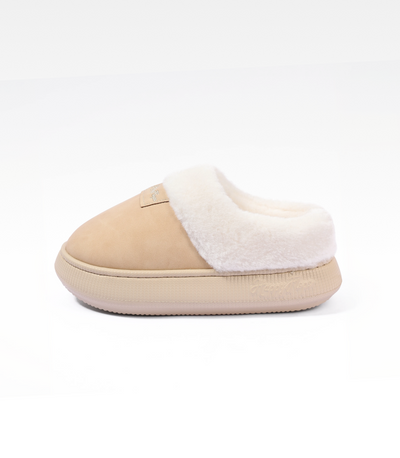
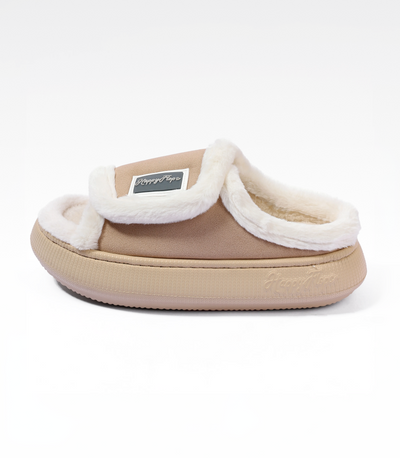
HappyCozy: Built Around All Four

HappyFlops built its name on thick, lightweight EVA footwear — the kind of sole people describe, slightly embarrassed, as walking on a cloud. HappyCozy is that sole, taken into winter.
Which is the important distinction. Most winter slippers start with fluff and hope for the best. HappyCozy starts with 4.5 cm of lightweight EVA and wraps it in soft vegan fur. You get the warmth of a plush house slipper and something genuinely substantial underneath it.
-
4.5 cm of lightweight EVA underfootA thick, cushioned platform between you and the floor — with none of the weight you'd expect from that much sole.
-
Soft vegan fur liningWarmth that stays breathable. No real fur, no animals involved, and the kind of softness you want to touch before you've even put them on.
-
Non-slip outsoleSteady footing on tile, laminate and stairs.
-
Water-resistant, indoor and outdoorBins, garden, post, quick errand. You don't change shoes. That's the whole point.
★★★★★“Okay… I don't usually write reviews, but this thing deserves one. As soon as I opened the bag, it's SO fluffy. Like, not fake fluffy, actually thick and soft in a way that feels expensive. I was worried it'd be too warm because it's over-stuffed, but it somehow stays perfect without making me sweat.”
— Marjon P., verified customer
| HappyCozy | Ordinary house slippers | |
|---|---|---|
| Thick 4.5 cm EVA platform | ||
| Warm without feeling sweaty | ||
| Non-slip outsole | ||
| Water-resistant | ||
| Wearable indoors AND outdoors | ||
| Vegan & hypoallergenic | ||
| Holds its shape past one season |

THE FIRST MORNING
That first step out of bed shouldn't be the worst part of your day.
Cold floor, bare feet, the little flinch. Then, instead: warm lining, something soft and thick underfoot, and the day starts about forty percent better than it did yesterday.
People buy these for the cold floors. They keep wearing them because of what's underneath.
-
30-DAY MONEY-BACK GUARANTEEWear them. Feel them. Decide for yourself. (Less than 0.5% of buyers use it.)
-
DESIGNED IN SWEDENBuilt around comfort, practicality and everyday wear.
-
1,000,000+ HAPPY CUSTOMERS
-
REAL HUMAN SUPPORTWe're quick, and we actually like talking to you.
Not Sure HappyCozy Is Your Pair?

The winter argument holds either way — it's the hours, not the model. Two alternatives, depending on what your house is like:
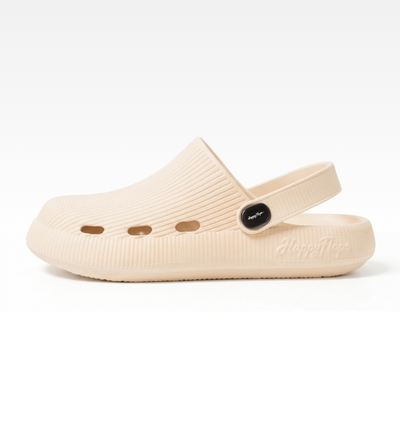
HappyComfy — if you run warm, or your home isn't freezing.
The same thick EVA platform, without the fur lining. The comfort underfoot stays; the warmth dials down. Better for heated apartments and for people who'd rather not be in fur by March.
Shop HappyComfyHappyFluffs — if you want maximum softness.
The plushest thing in the range. Made for people whose priority is the sink-in feeling above all else.
Shop HappyFluffs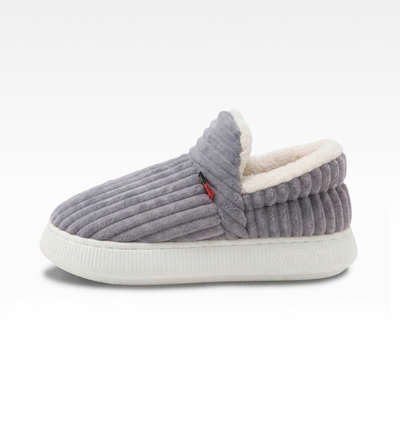
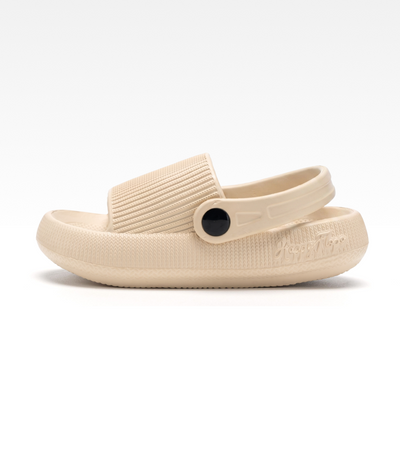
You're going to spend the next five months indoors, on your feet, on hard floors.
You can do it in whatever's currently by the door — or you can spend about the price of one takeaway and do it on 4.5 cm of proper cushioning instead.
It's not a big decision. It's just one nobody ever makes on purpose.
30-day money-back guarantee · 1,000,000+ customers · Free returns
Can I really wear them outside?
Yes — that's the point of the water-resistant, non-slip outsole. Bins, garden, post, short errands. They're not hiking boots, but you won't be changing shoes eight times a day.
Are they too warm for a heated house?
The vegan fur lining is breathable, so most people are fine. If you run genuinely hot, HappyComfy is the same sole without the lining.
How do I choose a size?
⚑ TO FILL IN — the sizing line — e.g. "true to size, size up if between sizes"
Are they vegan?
Yes. No real fur, no animal materials.
What if they're not for me?
30 days, money back, easy returns.


